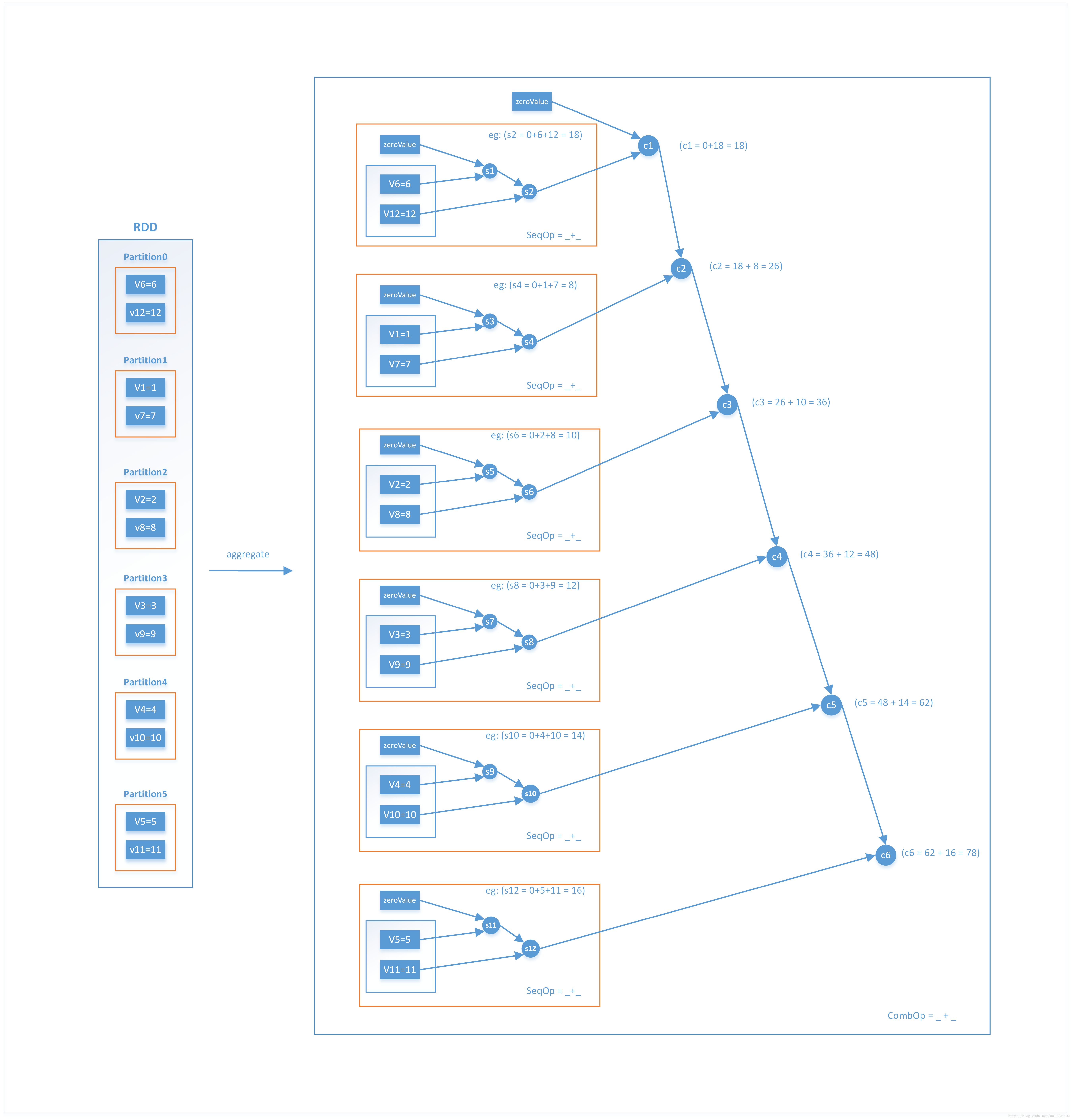
/**
 * Aggregate the elements of each partition, and then the results for all the partitions, using
 * given combine functions and a neutral "zero value". This function can return a different result
 * type, U, than the type of this RDD, T. Thus, we need one operation for merging a T into an U
 * and one operation for merging two U's, as in scala.TraversableOnce. Both of these functions are
 * allowed to modify and return their first argument instead of creating a new U to avoid memory
 * allocation.
 *
 * @param zeroValue the initial value for the accumulated result of each partition for the
 *                  `seqOp` operator, and also the initial value for the combine results from
 *                  different partitions for the `combOp` operator - this will typically be the
 *                  neutral element (e.g. `Nil` for list concatenation or `0` for summation)
 * @param seqOp an operator used to accumulate results within a partition
 * @param combOp an associative operator used to combine results from different partitions
 */123456789101112131415
def aggregateByKey[U: ClassTag](zeroValue: U, partitioner: Partitioner)(seqOp: (U, V) => U,
    combOp: (U, U) => U): RDD[(K, U)] = self.withScope {
  // Serialize the zero value to a byte array so that we can get a new clone of it on each key
  val zeroBuffer = SparkEnv.get.serializer.newInstance().serialize(zeroValue)
  val zeroArray = new Array[Byte](zeroBuffer.limit)
  zeroBuffer.get(zeroArray)

  lazy val cachedSerializer = SparkEnv.get.serializer.newInstance()
  val createZero = () => cachedSerializer.deserialize[U](ByteBuffer.wrap(zeroArray))

  // We will clean the combiner closure later in `combineByKey`
  val cleanedSeqOp = self.context.clean(seqOp)
  combineByKeyWithClassTag[U]((v: V) => cleanedSeqOp(createZero(), v),
    cleanedSeqOp, combOp, partitioner)
}123456789101112131415
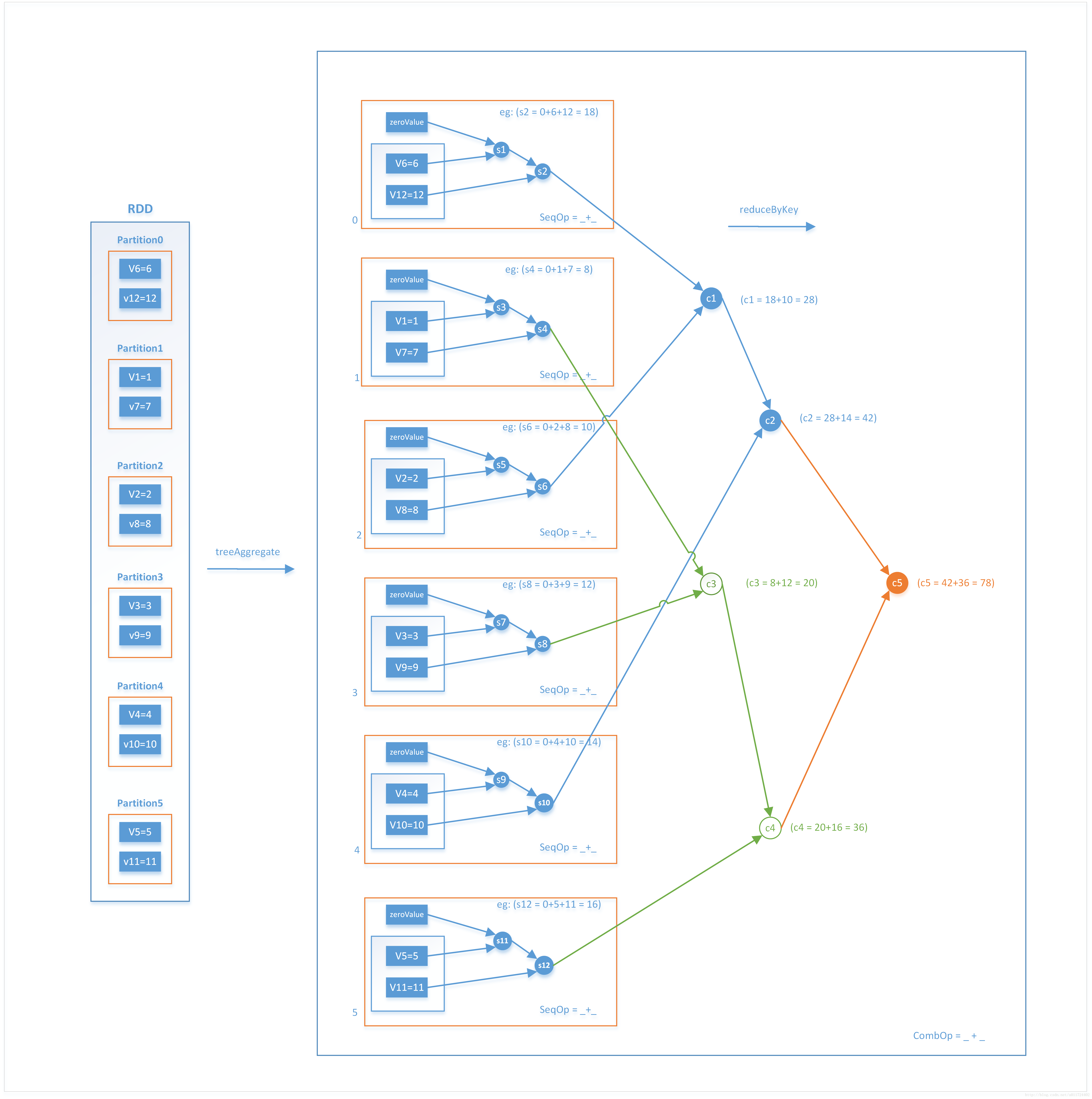
/** * Aggregates the elements of this RDD in a multi-level tree pattern. * * @param depth suggested depth of the tree (default: 2) * @see [[org.apache.spark.rdd.RDD#aggregate]] */ deftreeAggregate[U: ClassTag](zeroValue: U)( seqOp: (U, T) => U, combOp: (U, U) => U, depth: Int = 2): U = withScope { require(depth >= 1, s"Depth must be greater than or equal to 1 but got $depth.") if (partitions.length == 0) { Utils.clone(zeroValue, context.env.closureSerializer.newInstance()) } else { val cleanSeqOp = context.clean(seqOp) val cleanCombOp = context.clean(combOp) val aggregatePartition = (it: Iterator[T]) => it.aggregate(zeroValue)(cleanSeqOp, cleanCombOp) var partiallyAggregated = mapPartitions(it => Iterator(aggregatePartition(it))) var numPartitions = partiallyAggregated.partitions.length val scale = math.max(math.ceil(math.pow(numPartitions, 1.0 / depth)).toInt, 2) // If creating an extra level doesn't help reduce // the wall-clock time, we stop tree aggregation.
// Don't trigger TreeAggregation when it doesn't save wall-clock time while (numPartitions > scale + math.ceil(numPartitions.toDouble / scale)) { numPartitions /= scale val curNumPartitions = numPartitions partiallyAggregated = partiallyAggregated.mapPartitionsWithIndex { (i, iter) => iter.map((i % curNumPartitions, _)) }.reduceByKey(newHashPartitioner(curNumPartitions), cleanCombOp).values } partiallyAggregated.reduce(cleanCombOp) } }1234567891011121314151617181920212223242526272829303132333435